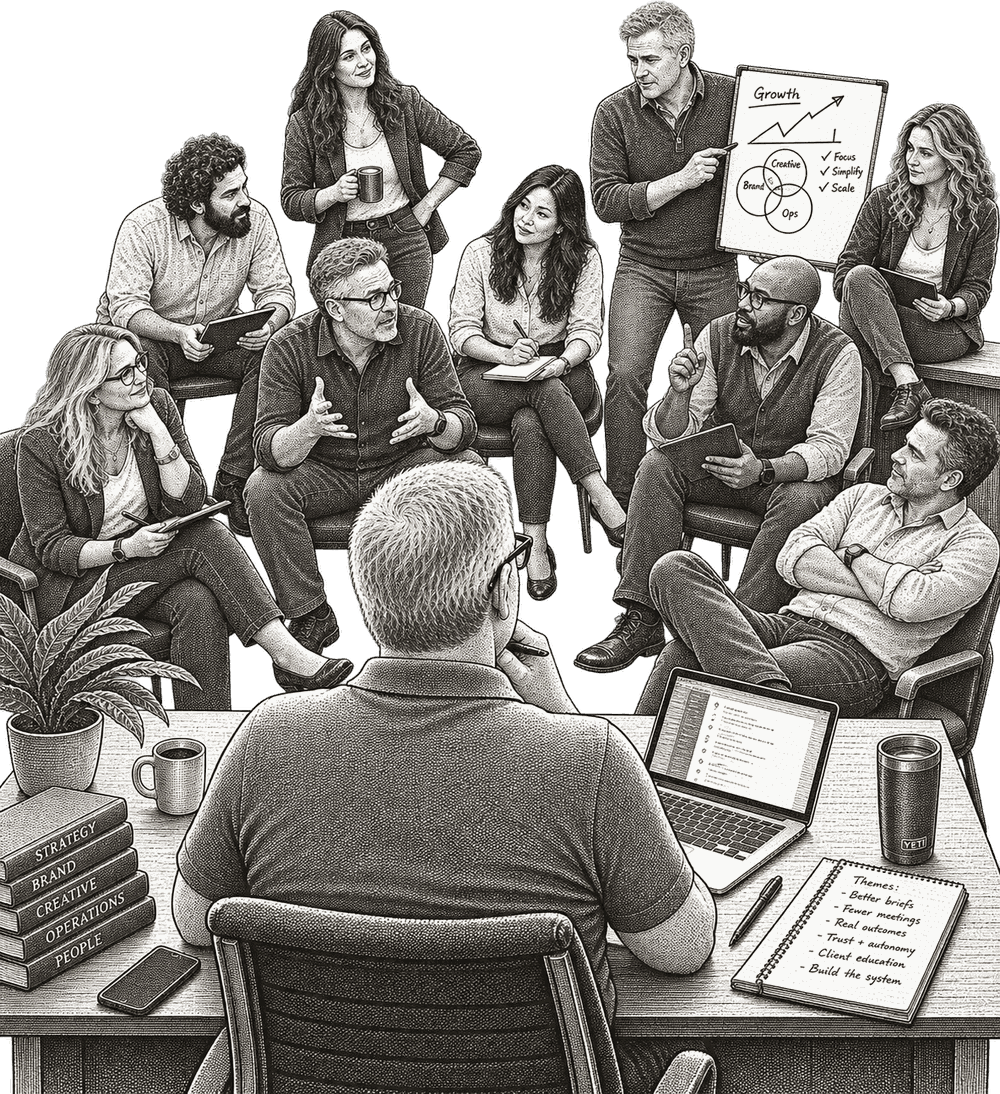
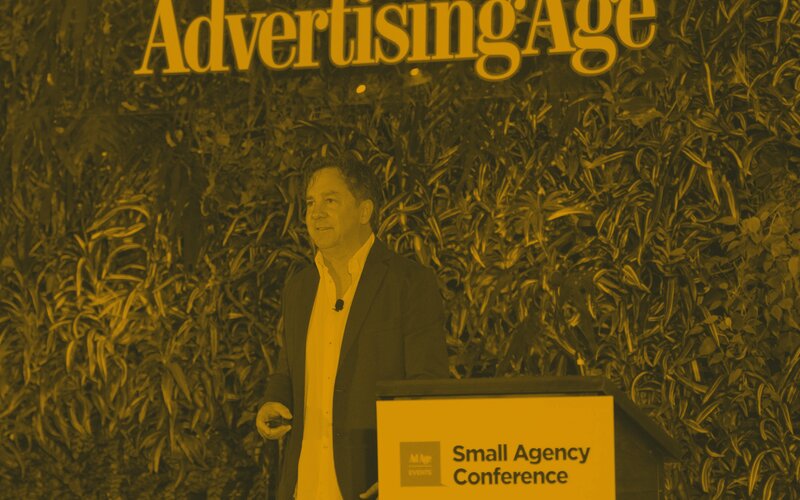
That’s where I come in.
I work with agency leaders and their teams to find better ways of working together. Most owners have the right instincts about their business. I bring the insight, guidance, and methods to make your vision achievable.
Let’s get started.
Book a Conversation →
The question that started all of this was simple: why do smart people build organizations that make everyone worse at their jobs? I spent four years at RAND as a management scientist trying to answer it, studying how organizations produce outcomes their designers never intended. I got an MBA at USC studying why owner-operated businesses thrive or eat themselves alive. Then I ran Sapient’s Los Angeles office, 105 people, and discovered I was part of the problem.
I built two companies after that (PDIT and Modulant, both made the Inc. 500), sold my share, trained in leadership coaching at the Hudson Institute, and went looking for the answer in a different place: inside other people’s agencies. That was fifteen years and 200+ engagements ago. The methods I built along the way became AgencyAgile. The book I wrote about what I learned, UNMANAGED, won six awards, five of them golds. The question I am working on now is the one every agency owner is asking: what happens when AI changes what clients will pay for.
Every org chart I’ve ever seen describes reporting lines. None of them describe how work actually moves through the building.
Agencies love to cut meetings. They almost always cut the coordination ones and keep the status ones.
Management layers that don’t touch the work create distance from the client. The distance is invisible until the client points it out by leaving.
Family is an accountability-free metaphor. The firms that work well together have something more specific than love. They have shared language.
Agencies have always been businesses in motion. New clients, new services, a growth spurt, going remote, and now AI: there’s always something, and every shift quietly pulls the way the firm runs out of alignment with what the firm has become. Running an agency well is largely the ability to realign as change happens. It’s a skill, and it’s hard to exercise if you’ve never done it or watched it done; most owners are facing this round for the first time. Done well, realignment does more than fix the drift; it reinvigorates the place. I’ve been in the room for hundreds of these.
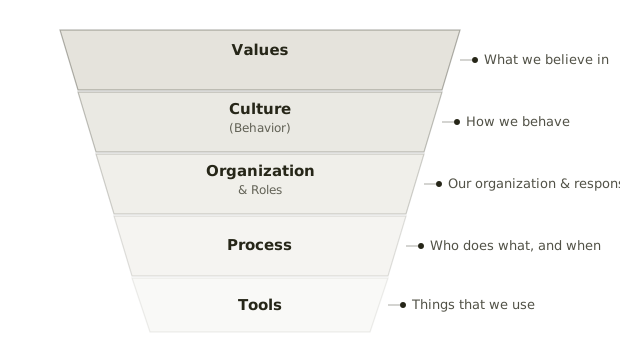
Every agency mission, vision, or values statement I’ve ever read commits to the same three things: brilliant work and happy clients; passionate, engaged people who love the work and the company; and healthy growth and margin. Nobody needs help writing that. The drift shows up as a distance between the wall and the Monday, and it hides in five places.
The drift hides in five places.
Pick your proudest value. What’s the most common behavior in your firm that quietly refutes it, and how will you change that?
What I do: I find these gaps with the whole agency, using a participatory workshop: the Agency Diagnostic, which comes in several flavors. It gives us the target list and the metrics we need to start making changes.
Who in your firm hasn’t been asked for their thinking in a month, and how did a disempowering process find its way in?
What I do: Growth makes execution harder, and the firm flexes inward, losing sight of, and the capability for, deep engagement with clients. I teach rituals that reinvigorate how people work together, and with clients.
What does someone in one of your departments believe about another department that they’d never say in a mixed room, and what’s your evidence it isn’t true?
What I do: I simplify structures: less complexity, less hierarchy, and bring people back together for more efficient, more enjoyable execution.
Where are your leaders spending their time: sorting out org charts and promotions, or elevating the conversation with clients, present and future?
What I do: Realigned functions and a focus on value creation reshape managerial thinking. Where it’s needed, I coach individuals on the leadership and management team.
Count the tools your firm runs on. How many are bending your people to their way of working, and how many have dissolved into everyone doing their own thing?
What I do: Tools either try to do too much or too little. I help leadership teams rationalize, often reduce, their reliance on tools, cutting cost and smoothing operational flow.
And now this.
AI collapsed the cost of the assembly layer: drafting, structuring, producing. Machines do it faster and cheaper by the month. Most agencies responded by doing the cheap work faster. That is not a strategy.
The question is what clients will still pay for. Research on what drives the highest client ratings tells a striking story: out of 91 attributes that clients evaluate, work quality ranks only #30. The firms that earn the highest ratings are the ones whose clients feel strategically supported. Clients who rate an agency 9 or 10 are three times more likely to praise the experience of working together than the quality of the output.
When production becomes cheap, the only thing keeping you in the room is whether the client experiences your judgment directly. That is a structural problem. And it is solvable.
Out of 91 attributes, work quality ranks only #30 in what drives the highest client ratings. The top-rated agencies are the ones whose clients feel most strategically supported.
It will happen with them.
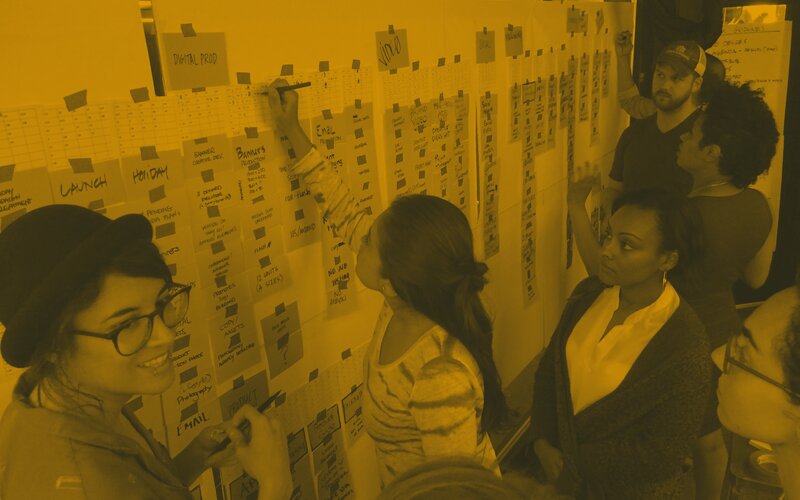
Real change in an agency doesn’t come from a presentation deck or a new set of rules. It comes from changing how people see their own work and giving them the language to talk about it differently. That’s how buy-in happens: by involving people in building the solution. Adults learn by doing, and the changes that stick are the ones the team helped create. My methods are designed around this. We work with your people, on real projects, building solutions that touch the whole system at once, because pulling on one thread in an agency moves everything else.
Agencies advised. Over 15 years of structural work.
Paid back within 3 months. Level 1 cost recovered on first project.
Likely or very likely to recommend.
Faster delivery. More work per hour, less rework.
If something here resonated, I’d like to hear about it.
30 minutes. No pitch, no deck. You tell me what’s not working; I’ll tell you what I’d look at first.
Book a Conversation →Prefer email? Tell me a bit about your agency and what’s on your mind. I’ll get back to you personally.
Send a Message →